1.0 Είμαστε τελικά σπορά της τύχης ?

NEA από όλο τον Κόσμο - RSS news Portal
Εμφάνιση αναρτήσεων με ετικέτα TEXNΟΛΟΓΙΑ. Εμφάνιση όλων των αναρτήσεων
Εμφάνιση αναρτήσεων με ετικέτα TEXNΟΛΟΓΙΑ. Εμφάνιση όλων των αναρτήσεων
Τετάρτη 13 Απριλίου 2011


Τρίτη 5 Απριλίου 2011
carcinogenic and mutagenic for up to 250,000 years, or 12,000 human generations.
No safe levels' of radiationSullivan uses Fukushima reactor No. 3 as an example, because it is fueled with Mox fuel uranium and plutonium. Plutonium has a half-life of 24,000 years, which means it is carcinogenic and mutagenic for up to 250,000 years, or 12,000 human generations. >>> FUKUSHIMA .. the war is lost..
--------------------------------------------------------------
--------------------------------------------------------------
Ιn a nuclear crisis that is becoming increasingly serious, Japan’s Nuclear Safety Agency confirmed that radioactive iodine-131 in seawater samples taken near the crippled Fukushima Daiichi nuclear power complex that was seriously damaged by the recent tsunami off the coast of Japan is 4,385 times the level permitted by law. Airborne radiation near the plant has been measured at 4-times government limits. Tokyo Electric Power Company, the company that operates the crippled plant, has begun releasing more than 11,000 tons of radioactive water that was used to cool the fuel rods into the ocean while it attempts to find the source of radioactive leaks. The water being released is about 100 times more radioactive than legal limits.
Πέμπτη 31 Μαρτίου 2011
FUKUSHIMA .. the war is lost..

Letters from Fukushima ..The Heroes of Japan and the lost war
Disaster-hit Japan faces protracted nuclear crisis
The firm's chairman said it had 'no choice' but to scrap reactors No 1- 4, but held out hope that the remaining two could continue to operate
Disaster-hit Japan faces protracted nuclear crisis
The firm's chairman said it had 'no choice' but to scrap reactors No 1- 4, but held out hope that the remaining two could continue to operate
Justin McCurry in Tokyo- guardian.co.uk, Thursday 31 March 2011 04.43 BST

The plant’s operator, Tokyo Electric Power said the reactors would be scrapped, and warned that the operation to contain the nuclear crisis could last months Photograph: Ho/Reuters
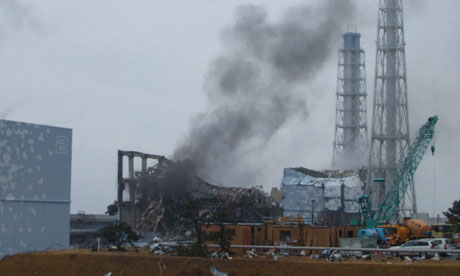
The plant’s operator, Tokyo Electric Power said the reactors would be scrapped, and warned that the operation to contain the nuclear crisis could last months Photograph: Ho/Reuters
Japanese officials have conceded that the battle to salvage four crippled reactors at the Fukushima Daiichi power plant has been lost. The plant's operator, Tokyo Electric Power [Tepco], said the reactors would be scrapped, and warned that the operation to contain the nuclear crisis, now well into its third week, could last months. Tepco's announcement came as new readings showed a dramatic increase in radioactive contamination in the sea near the atomic complex. The firm's chairman, Tsunehisa Katsumata, said it had "no choice" but to scrap the Nos 1-4 reactors, but held out hope that the remaining two could continue to operate. It is the first time the company has conceded that the at least part of the plant will have to be decommissioned.
Δευτέρα 28 Μαρτίου 2011
Disaster-hit Japan faces protracted nuclear crisis

also >>Letters from Fukushima ..The Heroes of Japan ..
http://garizo.blogspot.com/2011/03/letters-from-fukushima-heros-of-japan.html
----------------------------------------------------------------
(Reuters) - Japan appeared resigned on Monday to a long fight to contain the world's most dangerous atomic crisis in 25 years after high radiation levels complicated work at its crippled nuclear plant.Engineers have been battling to control the six-reactor Fukushima complex since it was damaged by a March 11 earthquake and tsunami that also left more than 27,000 people dead or missing across Japan's devastated northeast.A magnitude 6.5 earthquake rocked the region on Monday, the latest in a series of aftershocks, and officials warned it would trigger a 50-cm (two feet) tsunami wave.Radiation at the nuclear plant has soared in recent days. Latest readings on Sunday showed contamination 100,000 times normal in water at reactor No. 2 and 1,850 times normal in the nearby sea.
Παρασκευή 25 Μαρτίου 2011

Τρίτη 22 Μαρτίου 2011

Τρίτη 11 Ιανουαρίου 2011
Obama administration moves forward with unique internet ID for all Americans
Obama administration moves forward with unique internet ID for all Americans
President Obama has signaled that he will give the United States Commerce Department the authority over a proposed national cybersecurity measure that would involve giving each American a unique online identity. Other candidates mentioned previously to head up the new system have included the NSA and the Department of Homeland Security, but the announcement that the Commerce Department will take the job should please groups that have raised concerns over security agencies doing double duty in police and intelligence work.So anyway, what about this unique ID we'll all be getting? Well, though details are still pretty scant, U.S. Commerce Secretary Gary Locke, speaking at an event at the Stanford Institute, stressed that the new system would not be akin to a national ID card, or a government controlled system, but that it would enhance security and reduce the need for people to memorize dozens of passwords online.The Obama administration is currently drafting what it's dubbed the National Strategy for Trusted Identities in Cyberspace, which is expected at the Department of Commerce in a few months.
Τετάρτη 8 Δεκεμβρίου 2010
green energy out of necessity ... in GAZA strip
green energy out of necessity
cooking and distilling water using the solar energy in Gaza, as sun seems to be the only available source of energy over there, ....thanks to Israel - NATO joint efforts..
Πέμπτη 21 Οκτωβρίου 2010
Ο 1ος Παγκόσμιος Πόλεμος του Λογισμικού ξεκίνησε ..
Ο 1ος Παγκόσμιος Πόλεμος του Λογισμικού ξεκίνησε με αφορμή τη Java!
Γενική Κάτοψη των Δυνάμεων
 Ο 1ος Παγκόσμιος Πόλεμος του Λογισμικού έχει ξεκινήσει!!
Τα στρατόπεδα έχουν αρχίσει να συγκεντρώνουν δυνάμεις,
ενώ τα υψώματα των μαχών είναι προς στιγμήν το Android και το OpenOffice(LibreOffice πλέον).
Και ίσως η σημασία όλων αυτών στο μέλλον να είναι μεγαλύτερη από όσο θα φανταζόμασταν.
Ελεύθερο/Ανοικτό Λογισμικό
Από τη μία, το στρατόπεδο του Ελεύθερου Λογισμικού,με στρατό όλους τους προγραμματιστές στον πλανήτη που δεν έχουν πρόσωπο, ούτε τίτλους Ιδιοκτησίας.
Είναι οι "πεζικάριοι" και οι "ξεβράκωτοι".
Ένας στρατός που γεννήθηκε πρώτα στο μυαλό ενός ανθρώπου: του Richard Stallman.
Και χειρίζονται με δημοκρατικές, βέβαια, εναλλαγές, τα δικά τους "άρματα",
το GNU/Linux σε διάφορες μόντες (Debian, Ubuntu, Gentoo, Redhat), το Firefox, το Eclipse, τους Apache και Tomcat Web Servers, τις Perl και Python, κι άλλα τέτοια πολλά, και χιλιάδες μικρότερα.
Πρώτη φορά στην Παγκόσμια Ιστορία του Λογισμικού έχουν συναρμολογηθεί τόσα *πολλά* άρματα από το "λαό"!
Πέμπτη 28 Ιανουαρίου 2010
Sky launches 3D channel in pubs
 Fans will be able to enjoy 3D from the comfort of their bar stool |
Sky is kicking off the UK's first 3D channel with a live Premier League football match to be broadcast from nine pubs around the UK this weekend.
The match between Arsenal and Manchester United will be viewable in 3D in pubs in London, Manchester, Cardiff and Edinburgh. In April Sky will roll out its 3D channel to hundreds of other pubs.
Later in the year, Sky 3D will be made available to all Sky+HD customers with a range of content on offer.
This will include movies, sport, documentaries and entertainment.
Sky 3D will initially be available as a free add-on for those with Sky+HD boxes.
Viewers need to wear a special pair of glasses to watch the content.
There has been a great deal of hype around the technology since cinemas began showing films in 3D.
Avatar, shot in 3D, has become the highest grossing film of all time.
It is expected that 3D-ready TVs will hit the consumer market later this year.
"People have already embraced 3D cinema and because Sky's 3D service uses the same kind of technology, we're confident there will be demand for sport, movies, concerts and drama in 3D," said Gerry O'Sullivan, Sky's director of strategic product development.
In February, two rugby matches in the Six Nations championship will be filmed in 3D and shown at cinemas around the UK.
The 2010 World Cup will also be filmed in the format.
The BBC was the first to show a 3D sports event, broadcasting a Scotland v England rugby match at the Six Nations championship in 2008.
HOW 3D BROADCASTS WORK

Τετάρτη 20 Ιανουαρίου 2010
Apophis - ΑΠΟΦΙΣ- Τhe 27 million ton asteroid will close earth, in 2029!
Russia’s space agency has been holding meetings about Apophis – the asteroid due to pass close to Earth in 2029. If it is not diverted, a collision could potentially kill millions, scientists say.
“Apophis was discovered in 2004,” explains Boris Shustov, Director of the Institute of Astronomy. “The probability of a collision with the Earth was very high, about 1 to 30. The collision of such a large body with our planet will cause great damage.”
Although others have estimated the probability of the collision to be lower, an asteroid with a diameter of 300m is still a cause for concern. Scientists insist that the critical moment will come in 2029 when Apophis passes so close to Earth that it will be visible to the naked eye. Although there will be no threat of an impact at that particular moment, it is not until then that scientists will know whether or not the 27 million ton rock will eventually collide with Earth when it approaches it again in 2036. NASA has dismissed all fears saying the chances of a collision are remote. While the Russian space agency said it still wanted to be prepared.
“I think that exaggerating things and scaring ourselves would be incorrect,” admits Anatoly Koroteev, President of the Russian Academy of Cosmonautics. “But nonetheless, doing nothing and taking no measures would be wrong: all the more so, because the threat can be overcome.” NASA has estimated that if the asteroid were to collide with Earth, the blast would be a hundred thousand times more powerful than the atomic bombing of Hiroshima.
Blowing up Apophis with nuclear weapons to prevent the impact has been ruled out, as weapons of mass destruction are forbidden in space by international treaty. One potential strategy is to send up spacecraft to nudge and deflect the asteroid. If this is the case, NASA and the European Space Agency would be invited to take part once a mission is finalized, the Russian Space Agency has said
Τρίτη 19 Ιανουαρίου 2010
German News Media Challenge Google
German News Media Challenge Google


Google disclosed this weekend that Germany's Federal Cartel Office has informed the company of several official complaints that have been filed about the search engine giant to the antitrust authority. The company said that both the Federation of German Newspaper Publishers (BDZV) and the Association of German Magazine Publishers (VDZ) have filed a joint complaint. In addition, complaints have also been filed by Ciao.de, a Microsoft subsidiary, and Euro-Cities, who are asking Germany's antitrust authority to probe the company.
The publishers' complaint centers on Google search results, which use snippets of content from the Web sites of newspapers and magazines. Google doesn't pay publishers for the content, which it uses on Google News and other services. Publishers are calling for what they describe as "fair searching" -- in other words, that no results are treated preferentially by Google -- and for "fair sharing" of Google ad revenues with publishing houses whose content is used by the search engine. Publishers have complained that in its Google News service and other parts of the site, Google gives preference to its own content or that of partners in disseminating results, and that often the primary source for a news item is not listed prominently, the Frankfurter Allgemeine Zeitung newspaper reported in its Monday edition."We would like to know how things are organized and why certain sites are higher than others in the list of results. We also want a share of the ad revenue that we help generate with our elaborately produced content," a BDZV representative said in November. In Germany alone, Google generates €1.2 billion ($17.2 billion) a year on advertising in search results.
Google: 'We're Happy to Explain Our Products'
Two Web sites, Ciao.de and Euro-Cities, are also involved in the complaints. Ciao, a shopping site that entered into an advertising contract with Google's AdWord service before the company was acquired by Microsoft. Microsoft claims its contract with Google unfairly limits its own ability to sell advertising and that it lacks transparency because it doesn't give the company the ability to review if ad revenues paid by AdWords are correct. Meanwhile, executives at Euro-Cities, a Web site that sells digital maps, feel their business model is undermined by the free Google Maps service.
The Federal Cartel Office has given Google one week to respond to the complaints and it will then weigh those arguments before deciding whether or not to initiate formal proceedings.
"We're happy to explain our products and business practices to the Federal Cartel Office," Google Germany spokesman Kay Oberbeck said Saturday. "We're convinced that they do comply with German and European laws."
Κυριακή 17 Ιανουαρίου 2010
3D TV - the 2010 revolution has a name " REALD "


LG Brings Its First 3D LCD TV To Market
 After showing off its wares at CES this year, LG has finally announced that its first 3D LCD, the 47-inch 47LH50—will be up for purchase next month. Well, in Korea at least.
The new TV is based on the 47LH50—even sharing its model number—and is functionally identical, aside from the fact that it'll occasionally require you to don polarized 3D glasses. That model number is significant, and bodes well: the old 47LH50 made it to the US, so it's fair to say that this one will, too. No price info yet, but the old one nudged $2,000.
Three-dimensional TV is coming to a living room near you. But will the technology spur a consumer spending spree like digital and high-definition TV did before it? Or will 3D end up being the next big flop?
One thing is clear, TV manufacturers need something new to get people buying TVs. Over the last couple of years, TV manufacturers have experienced a sales boom as consumers upgrade to digital TVs in anticipation of thegovernment's mandated switch to digital TV broadcasts in February 2009. Eager shoppers have also been upgrading to high-definition TVs as movie studios, cable and satellite operators, and TV broadcasters have begun offering more programming in HD.
But as the economy worsens, the forecast for the TV market is looking grim. The LCD TV market is only expected to grow about 17 percent in terms of units shipped in 2009, according to research firm DisplaySearch. This is down from growth of about 29 percent in 2008. Plasma TV growth is also expected to suffer with the market only expected to grow by about 5 percent in 2009 compared with a 24 percent rise in 2008, DisplaySearch said.
As a result, TV makers are looking for the next hot thing to attract new consumers. And some are hoping 3D TVs could be it.
At this year's Consumer Electronics Show in Las Vegas, four of the top selling TV manufacturers--Samsung Electronics, Sony, LG Electronics and Panasonic--showed off their latest versions of 3D TVs. Panasonic set up a mini-home theater where its 103-inch, plasma 3D screen showed clips from New Line Cinema's Journey to the Center of the Earth and Walt Disney Pictures' animated film Bolt. They also showed high-definition 3D footage from NBC's broadcast of the 2008 Summer Olympics in Beijing.
While some manufacturers, such as Mitsubishi, Phillips, Samsung, and Sharp, have already begun selling 3D-ready TVs, the top four manufacturers plan to have new, advanced 3D TVs on sale toward the end of 2009 and into 2010.
But the big question is whether consumers, particularly American consumers, will be willing to upgrade to a new TV just because it has 3D. Pricing for today's 3D ready TVs is comparable to other flat-screen HDTVs. Samsung and Mitsubishi currently sell their 3D-ready TVs for between $1,000 and $2,800, depending on functionality. These prices are in line with average prices for HDTVs that don't offer 3D readiness.
Keisuke Suetsugi, a manager for the audio visual center at Panasonic, believes that even the newer, more advanced 3D TVs will not cost much more than TVs without 3D. So for consumers already in the market for a TV, adding 3D readiness might not add much cost. But will 3D be enough to compel cutting-edge consumers to replace their 2- or 3-year-old TVs? That's what TV manufactures are hoping.
Three-dimensional movies have been around since the 1950s. And for most of its lifespan the technology has been seen more as a gimmick than something that truly enhances the movie-going experience. But newer technology and advanced special effects are helping 3D movies break into the mainstream.
TV makers believe that much of the demand for 3D will come from Hollywood, which is pushing 3D in a big way. Last year, DreamWorks announced that all its films will be produced for 3D production beginning in 2009. The company has partnered with chipmaker Intel to build processors that will help make 3D in the home a reality.

NBA basketball fans watch a live 3D broadcast of Game 2 of the 2007 NBA finals.
(Credit: NBA)Sports leagues have also been experimenting with 3D technology. Both the National Basketball Association and theNational Football League have broadcast events and games in 3D to movie theaters.
From a technical standpoint, the technology is available and mature enough today to make 3D TVs available at a reasonable cost to consumers. But there are still a few drawbacks that could prevent 3D TV from becoming the next big thing in home entertainment.
For one, to get the really cool, immersive 3D experience without getting a massive head-ache, consumers will have to wear special glasses when they're watching TV in 3D. The glasses are needed because 3D imaging requires sending a different image to each eye. And the glasses help merge the images in the mind and trick the brain into thinking that it's seeing a single 3D image.
I checked out Panasonic's home theater in 3D. I must admit, the experience was phenomenal. I felt like I was on the floor at the Olympics opening ceremonies in Beijing right alongside the hundreds of dancers and drummers. But without the glasses, the image looked fuzzy.
Panasonic's Suetsugi admits that in a perfect world, consumers should be able to have the immersive 3D experience without wearing glasses. But he said that it will be at least 10 years before the technology is advanced enough to provide a similarly robust 3D experience without glasses.
"Glassless 3D would be ideal," he said. "But it's just not possible to do that now and get the same quality experience. You would need at least 50 times more pixels to get a display to provide the same 3D experience that we provide with our TV. We are still 10 years away from that kind of technology."
Taesoo Park, a chief research engineer at LG, which makes 3D display monitors for advertising and digital signage, agrees. LG plans to start selling its 3D TVs, which require glasses, late in 2009 or in the beginning of 2010. Its glassless digital signs were also on display at CES.
"Glassless 3D is available today for digital signage and advertising," Park explained. "But the technology is not ready for TVs, because it would hurt people's eyes or give them a headache to look at today's 3D displays for any length of time. It will be at least a decade before we can get the technology to make glassless TV a reality."
That said, some manufacturers claim they have developed technology that doesn't require glasses. Phillips uses a technology it calls WOWvx. 3M and Toshiba also showed off glassless 3D screens at CES. 3M has created a thin film technology that can be used to beam light selectively to the viewer's right and left eyes.
But glasses aren't the only thing that could hold back 3D adoption. Currently, there's no standard way to get 3D footage from the movie studios or from a live broadcasts to the home. Companies, such as Panasonic, are already working on developing a standard. But industry watchers fear that competing standards could emerge and spur another "format" war like the one that pitted HD DVD and Blu-ray against each other.
Panasonic's Suetsugi said he is hopeful that a common standard for 3D Blu-ray hardware, software, and TVs will emerge sometime this year, paving the way for 3D TV sales to pick up in 2010.
In addition to the standards issue, another hurdle for 3D TV has to do with the high production cost of shooting movies and events in 3D, as well as, the high cost of transporting the video across networks. Three-dimensional video requires multiple cameras for shooting. And it also requires multiple high-definition streams for transporting the video over carrier networks.
Regular standard definition television broadcasts consume more bandwidth capacity than other types of traffic like audio or text. High-definition video eats up even more. And it would likely take at least two full high-definition channels to broadcast live just one game in 3D.
This means that service providers, such as cable or satellite operators, would have to upgrade their infrastructure to handle the high bandwidth demands. Verizon, which is deploying fiber directly to consumers' homes for its Fios service, is already in good shape. But others such as Comcast and Time Warner Cable, are already finding it difficult to carve out enough bandwidth for regular HD video as well as Internet video on their networks.
"Transporting live, high-definition 3D streams is very expensive," said Steve Hellmuth, executive vice president of technology and operations for the NBA. "So there has to be sufficient demand and a pool of content before satellite and cable operators will devote resources to delivering it. I really think that Hollywood will initially drive adoption of 3D in the home."
The revolution will be televised in high definition 3D
On eve of Las Vegas consumer electronics showcase, expectations grow for internet TVs and the tablet computer

A guest wears 3D glasses as he watches a Mitsubishi 3D television during a media preview for the 2010 CES in Las Vegas Photograph: Mario Anzuoni/Reuters
Televisions enhanced with direct internet access and 3D displays will be among the most anticipated products unveiled when the world's biggest annual technology showcase kicks off in Las Vegas on Thursday.This year could see a revolution in televisions on high street sale as they converge with the web, allowing viewers to watch services such as the BBC's iPlayer and YouTube more conveniently.Manufacturers including Sony, Panasonic and LG are expected to launch sets with a broad range of new capabilities at the Consumer Electronics Show, including High Definition TV (HDTV) screens with the internet telephony service Skype built in, so people can use their TVs for video chats with friends and family anywhere in the world.The BBC launched a limited trial last month of the iPlayer on some high definition Freesat boxes – the free-to-air satellite service is increasingly integrated into TVs – and is anticipating even more viewers being online when the next generation of sets emerges.There is a scramble to profit on the hype surrounding 3D after cinema hits Avatar and Up. A number of companies will be debuting their attempts at high-quality 3D screens. The Discovery Channel could even announce plans to launch a 3D TV channel next year.The Las Vegas show is where the world's most powerful electronics brands fight for top billing: launches in the past include the DVD, the Xbox games console and the puzzle game Tetris.Last night's launch of the Nexus One phone – Google's rival to Apple's iPhone – sought to upstage the start of CES and the next big moment will come tomorrow night with a keynote speech from Microsoft's forceful chief executive, Steve Ballmer.The company has opened CES in the past by outlining a vision of where Microsoft believes the future is headed. Two years ago billionaire founder Bill Gates demonstrated a table with a built-in touch sensitive computer, the Surface, while last year Ballmer showed off Windows 7.
Announcements likely this year include new mobile phones, concepts for home entertainment – perhaps even a launch date for Project Natal, the motion-sensitive video gaming system unveiled last summer. Whatever Ballmer has up his sleeve, he will have to compete with announcements from rivals such as Sony, Samsung, and Google.Microsoft is not alone in looking for wow factor. Others include Nokia, the beleaguered mobile phone maker whose chief executive, Olli-Pekka Kallasvuo, will attempt to excite Friday's crowds with a new slate of gadgets. Alan Mulally, boss of car maker Ford, is expected to show off hi-tech concepts aimed at changing the future of driving."We expect them to say something fairly significant," said Gary Shapiro, head of the Consumer Electronics Association, which organises the show. "They are positioning themselves as a tech company rather than a car company."It is on the show's extensive floors that most surprises are likely. With more than 2,500 exhibitors and acres of floor space, weird and wonderful ideas have plenty of room to thrive. Exploding on the scene this year are tablet computers – touchscreen devices pitched between a laptop and a mobile phone. With Apple – which is not at CES itself – set to make an announcement later this month, rivals are hoping they can break into the market. Among these is Freescale, a US company which has announceda machine combining tablet and smartbook features. "We believe the tablet will emerge as a popular form factor for the next generation of smartbooks," said Henri Richard of Freescale.

Εγγραφή σε:
Αναρτήσεις (Atom)