Σελίδες

Εμφάνιση αναρτήσεων με ετικέτα ΛΑΤΙΝΙΚΗ ΑΜΕΡΙΚΗ. Εμφάνιση όλων των αναρτήσεων

Πέμπτη 19 Απριλίου 2012

Argentina announces expropriation of Repsol oil subsidiary YPF

ampliar foto
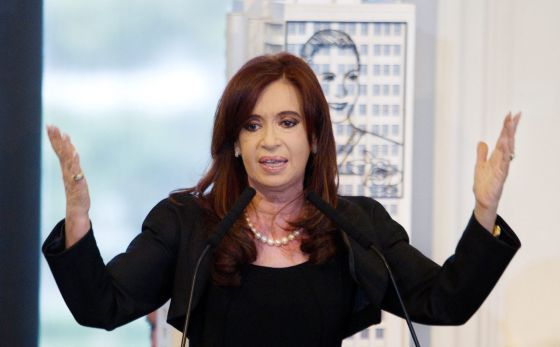
Fernández de Kirchner announcing Monday the expropriation of YPF. / LEO LA VALLE (EFE)

Argentina announces expropriation of Repsol oil subsidiary YPF

After weeks of speculation, Argentinean President Cristina Fernández de Kirchner announced on Monday that her government is going to nationalize the Spanish Repsol subsidiary YPF, declaring that her country’s hydrocarbon industry was a sector of “public interest.”
In a speech made in Buenos Aires after returning from the Americas Summit in Colombia, Fernández de Kirchner explained that she will send a law to Congress that proposed giving 51 percent control of YPF to the federal government and the remaining 49 percent to the country’s provinces.
In the coming days, the country’s appraisers will decide how much it will reimburse YPF for its shares.
“When one makes decisions in the interests of national management […] one also expects that managers understand the interests of the state,” Fernández de Kirchner said.
“We are the only country in America and one of the few in the world that doesn’t manage its own natural resources, but there were stronger arguments in favor of us taking this decision,” she said.
The nationalization came just days after Spain issued a stern warning against the Argentinean government not to take control of YPF, threatening to break “economic and fraternal” relations if the leftist Peronist administration of Fernández de Kirchner followed through with the plans.
In Madrid, María Dolores de Cospedal, secretary general of the ruling Popular Party (PP), said the government intends “to give an energetic response” after consulting with its European Union partners.
An EU delegation from Brussels was scheduled to arrive in Buenos Aires on Thursday to demand that Argentina respect the agreements it has signed with foreign investors.

------------------------------------------------
https://imagenes.repsol.com/es_en/YPF_Expropiacion_ing_tcm11-621728.pdf

Repsol acquisition

Repsol-YPF Tower
Spanish multinational corporation Repsol purchased 98% YPF in 1999 in two stages: a 15% share sold by the national government for US$2 billion, and a further 83% for over US$13 billion including all remaining public sector shares (10%, equally divided between the nation and the provinces) as well most of the outstanding investor shares. The union of the two companies took on the name Repsol YPF; YPF would represent 40% of the new firm's reserves and over 50% of its production.

Παρασκευή 19 Νοεμβρίου 2010

Haiti Rebellion Against United Nations Occupation Forces Spreads to Capital

Haiti Rebellion Against United Nations Occupation Forces Spreads to Capital

18 November 2010 
Last updated at 17:49 ET 
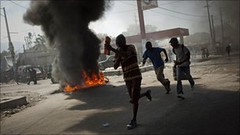
Haiti cholera clashes reach capital Port-au-Prince. Demonstrators vented their anger at the UN mission 
Protests linked to the outbreak of cholera in Haiti have spread to parts of the capital, Port-au-Prince.Police fired tear gas as demonstrators set up barricades and threw rocks at United Nations vehicles. On Monday, clashes between residents and UN troops in the north had left two people dead.Some Haitians blame UN peacekeepers from Nepal for bringing cholera to the country - a claim denied by the UN.US health experts say Haiti is vulnerable to further outbreaks.Sporadic gunfire could be heard on Thursday as protesters took to the streets of Port-au-Prince, which was devastated by a massive earthquake in January.Hundreds of youths erected barricades of burning tyres and attacked vehicles belonging to the UN mission (Minustah).


The protesters shouted slogans like: "Cholera: It's Minustah who gave it to us!" and "Minustah go home!" Cholera is present in all 10 of Haiti's regions. About 1,100 people have died from the disease since it emerged in the country last month.    Most of the 38 deaths recorded in the capital have been in the slum district of Cite Soleil.


Παρασκευή 22 Οκτωβρίου 2010

Student, 20, named police chief in Mexico

There's a new police chief in this violent borderland where drug gangs have killed public officials and terrified many citizens into fleeing: a 20-year-old woman who hasn't yet finished her criminology degree.
Student, 20, named police chief in Mexico
Twenty-year-old Marisol Valles Garcia listens to a question during a news conference after her swearing-in ceremony as the new police chief of the bordertown of Praxedis G. Guerrero, near Ciudad Juarez, Mexico, Wednesday, Oct. 20, 2010. [Agencies] 
Marisol Valles Garcia was sworn in Wednesday to bring law and order to a township of about 8,500 that has been transformed from a string of quiet farming communities into a lawless no man's land. Two rival gangs -- the Juarez and Sinaloa drug cartels -- have been battling for control of its single highway, a lucrative drug trafficking route along the Texas border.

The tiny but energetic Valles Garcia, whose only police experience was a stint as a police department secretary, says she wants her 12 officers to practice a special brand of community policing. In fact her plan is to hire more women -- she currently has three -- and assign each to a neighborhood to talk with families, promote civic values and detect potential crimes before they happen.
"My people are out there going door to door, looking for criminals, and (in homes) where there are none, trying to teach values to the families," she said in her first official appearance on Wednesday. "The project is ... simple, based on values, principles and crime prevention in contacts house-by-house."
She has been assigned two bodyguards but won't carry a gun. She says she leave most of the decisions about weapons and tactics to the town's mayor, Jose Luis Guerrero.

Τρίτη 12 Οκτωβρίου 2010

Rescued Chile miners reach surface


Rescued Chile miners reach surface


Three of the 33 Chilean miners trapped in a collapsed mine for more than two months have been raised through a small rescue tunnel in a skinny, missile-like capsule nicknamed "Phoenix".Florencio Avalos, a 31-year-old driver, was the first miner to be rescued on Wednesday and was chosen because he was considered among the most physically and mentally fit of the group.He smiled broadly as he emerged and hugged his sobbing 7-year-old son and wife. He then embraced Sebastian Pinera, the president who is at the scene overseeing the rescue operation.The president described how lovely it was to see Avalos' son greet their father."I told Florencio, that few times have I ever seen a son show so much love for his father," Pinera said."This won't be over until all 33 are out," he said. "Hopefully the spirit of these miners will remain forever with us ... This country is capable of great things."Avalos was then was escorted into a medical triage centre for the first of a battery of tests.The miners are pulled up through a 600-metres-deep shaft in a rescue capsule wide as the shoulders of an average built miner, designed specifically for the operation. The miners can communicate with rescue teams using an intercom in the capsule.Quick rescue Mario Sepulveda, a 39-year-old electrical specialist, was the second to reach the surface. After hugging his wife, he jubilantly handed souvenir rocks to laughing rescuers."I'm so happy!" Sepulveda yelled, punching his fist in the air and hugging everyone in sight.Al Jazeera's Lucia Newman, reporting from the mine, said it took only 16 minutes for Avalos to be pulled up the shaft.

Δευτέρα 11 Οκτωβρίου 2010

Homeless Venezuelans to get homes from government

Homeless Venezuelans to get homes from government

Brazil News.Net
Sunday 10th October, 2010 (IANS)
Over 1,000 homeless people, living in temporary shelters here in the Venezuelan capital, would be given homes bought from private builders by the government in the South American nation.

President Hugo Chavez said the government will purchase 1,138 homes from builders and donate them to people currently living in shelters in Caracas.

'These houses are for people left homeless in recent days in Caracas. They'll have their own home,' Chavez said.

The government would invest 258 million bolivars ($60 million) in the purchase.

Housing is denied to the poorest in a capitalist system, Chavez said.

'The hills filled with shantytowns in Caracas are the result of those 100 years of capitalism, in which the rich would live in estates and the poor there, in the shantytown. By contrast, in socialism we're all equal,' Chavez said.

Σάββατο 2 Οκτωβρίου 2010

Συντεχνιακή - Εργατική - Ανθρώπινη αλληλεγγύη (miners are miners no matter what country they are from.)


The 33 Chilean miners trapped for almost two months could be freed in the second half of this month as rescuers drill closer to their refuge deep below the Atacama desert, Chile's mining minister said on Friday.The men have been trapped 2,300 feet underground since a cave-in on August 5. "The eventual rescue could come in the second half of October," said Mining Minister Laurence Golborne.Rapid progress by the rescue drills has raised expectations of reaching the miners in October instead of November as first thought.Rescuers will use metal cages designed by Chile's navy to winch the men to the surface one at a time. Doctors said the workers have started exercising in preparation for the ride back to the surface.The trapped men, who include a first-time miner, a former soccer star and a Bolivian immigrant, have also started preparing for the trip home by sending up the gifts that have been sent down to them through small ducts over past weeks."The capsule is tiny, without space for all his stuff. So he's sending it up bit by bit," Juan Sanchez, father of trapped 19-year-old miner Jimmy Sanchez told state television


one of the American miners explained why it was no question that he and his team wanted to help the trapped Chileans, saying, “We have the ability to help them out, and that’s the whole reason we are here. Miners are miners; it doesn’t matter what country they are from.
Having arrived by helicopter, a beaming President Sebastián Piñera confirmed the news and waved one of the messages. “We are well and in a refuge,” it read. “The 33.” 

US media ignore Ecuador chaos and anarchy


While chaos and anarchy break out in Ecuador, the US media ignored the attempted coup. Are there more important topics on their mind, or is it simply that no one cares?  f you prefer to think outside the box, would you go to a little box called television for information? Because if you do turn to TV, you are likely to not find what you are looking for. But what if the story is big and the media is just not covering it?


Violent clashes, chaos and anarchy broke out in Ecuador. But the attempted coup d’état was not being focused on by the main TV networks in the US. Instead, a CNN presenter, reporting on the situation around the world, put on a pair of underwear and informed the world that the Naked Cowboy – one of New York's main tourist attractions –

Κυριακή 22 Μαρτίου 2009

Venezuelan army 'seizes ports'

Venezuelan army 'seizes ports'
The takeover aims to bring the country's major transportation hubs under federal control [AFP] . Venezuela's military has taken control of all the country's major airports and sea ports, a move that critics say is meant to limit the powers of mayors, governors and other potential rivals to Hugo Chavez, the president.Chavez said on Saturday: "Since this morning we began to reverse the disintegration of national unity."The takeover, which was approved by the country's parliament, aims to bring the country's major transportation hubs under federal control this year."We are reunifying the motherland, which was in pieces. This is a very important step," Chavez said. The measure also prohibits states and municipalities from collecting tariffs or tolls at transportation hubs or on highways, cutting off a key source of funding for local projects that could otherwise compete with federal handouts, Abelardo Daza, a Caracas-based economist, said. Soldiers were seen occupying major facilities under the legal reform approved by the pro-Chavez parliament, taking over maritime terminals in the opposition stronghold city of Maracaibo in the state of Zulia, the port of Guanta in Anzoategui and others in the states of Carabobo and Nueva Esparta. Chavez announced the move last week and threatened to arrest opposition governors if they resisted. Many opponents decried the order as unconstitutional and as an attempt to concentrate all power in Chavez's hands.
Budget cut
Also on Saturday, Chavez reduced the size of the 2009 budget by 6.7 per cent to $72bn, in what he said was part of a set of measures to offset lower oil revenue in the Opec nation. Chavez also reduced Venezuela's budgeted oil price estimate to $40 per barrel from $60 and lowered the oil output estimate to 3.17m barrels a day from about 3.67m. Mariana Sanchez, Al Jazeera's correspondent in the capital Caracas, said: "The president is explaining to the people that the world economic crisis has not affected Venezuela directly, but the slump in oil prices has. "So he announced the 6.7 per cent reduction in the national budget and has asked for the co-operation of all state officials in the implementation of these measures." Chavez promised on Saturday to send a revised budget to the legislature in coming days. Venezuela depends on oil for 93 per cent of exports and nearly half its federal budget. Crude prices are now 65 per cent below their July 2008 peak.

Πέμπτη 4 Δεκεμβρίου 2008

Bolivia to distribute land to indigenous Indians

The Bolivian government will buy land for distribution among members of indigenous Indian communities living in virtual serfdom, EFE reported Wednesday.Juan Carlos Rojas, chief of the National Institute for Agrarian Reform, told reporters Tuesday that the measure would benefit the indigenous communities in the eastern and southern provinces of Santa Cruz, Chuquisaca and Tarija.Bolivia's indigenous Indian communities live in appalling indigence with little access to education or health care.The Inter-American Commission on Human Rights had pointed out in its report in June that the Guarani Indians in Chaco area are living under 'a situation of servitude analogous to slavery.'Rojas said the government's land distribution plan would also address the indigenous communities' education and health care problems.The government's agrarian reform has encountered violent opposition in Santa Cruz, Chuquisaca and Tarija, where land barons remain opposed to the idea of breaking up individual holdings - some comprising nearly one million acres - to provide plots for landless peasants.According to figures compiled by the United Nations, Bolivia's richest 100 rural families hold five times as much acreage as two million poor peasants.

Παρασκευή 28 Νοεμβρίου 2008

Medvedev reaches Cuba

Medvedev reaches CubaDmitry Medvedev is in Cuba. He's the first Russian president to visit the country in eight years. This is the last stop of Medvedev’s tour of countries in Latin America, aimed at restoring links and boosting trade. The first stop for Medvedev upon arriving in Havana was the José Martí memorial. The Russian president laid wreathes at the Cuban national hero’s monument.Medvedev flew in from Venezuela, where he had taken his Venezuelan counterpart Hugo Chavez on a tour of a Russian destroyer.

Πέμπτη 27 Νοεμβρίου 2008

Medvedev talks arms and energy in Caracas

Medvedev talks arms and energy in Caracas.
Military links and joint energy ventures have dominated talks between the Russian and Venezuelan leaders in Caracas. Dmitry Medvedev is the first Russian leader to pay an official visit to Venezuela in more than 150 years of relations between the two countries. The sides have agreed to set up a joint bank and abolish the visa regime for travellers between the countries.The Russian leader has also said that Moscow is ready to work more closely with OPEC in the oil markets to ensure stable and fair prices."Russia and Venezuela are two energy giants and they are uniting at present," Chavez commented. "We need to consolidate co-operation with OPEC and also with other states in order to restore oil prices, to bring stability to prices that are affected by the crisis."The Russian leader also stressed that Russia and Venezuela intend to continue to develop bilateral military-technical cooperation."We will continue this co-operation," Medvedev stated. "We have exchanged our ideas with the president (of Venezuela) how and what we will do."On Thursday, both heads of state will meet on board the Russian warship "Peter the Great", which is taking part in joint military exercises with the Venezuelan navy.The arrival of Russian warships in Venezuela has been labelled by some critics as an attempted show of force in America's backyard. Russian officials, however, say the exercise has nothing to do with Washington.

Τρίτη 25 Νοεμβρίου 2008

Chavez welcomes Russian warships

Russian warships have sailed into a Venezuelan port in the first deployment of its kind in the Caribbean since the end of the Cold War. The vessels were greeted by a 21-gun military salute on Tuesday at the start of a week of joint manoeuvres as Moscow and Caracas seek to strengthen their political and trade ties. The ships, including the nuclear-powered cruiser Peter the Great and the destroyer Admiral Chabankenko, arrived at La Guaira, a port near to the capital Caracas, to coincide with a two day visit by Dmitry Medvedev, the Russian president. Vice-admiral Luis Morales Marquez, a Venezuelan operations commander, said the aim of the joint exercise was to "strengthen links of friendship and solidarity with the Russian fleet and the Bolivarian national armed forces". However, the move has been widely interpreted as a demonstration of the Kremlin's anger at the US over both its plans to install a missile-defence shield in eastern Europe and its decision to send aid-laden warships to Georgia this summer

Δευτέρα 24 Νοεμβρίου 2008

Chavez allies sweep state elections


Chavez allies sweep state elections
Allies of Hugo Chavez, the Venezuelan president, have won a majority in state elections for governors and mayors.With more than 95 per cent of votes counted, Venezuela's electoral agency said Chavez's allies have won 17 states in Sunday's vote.But the opposition has won two of the most populous states and the mayor's post in Caracas.They won in the two most populous states - Miranda and Zulia, as well as Nueva Esparta, Tibisay Lucena, president of the National Electoral Council, said.Turnout was 65.45 per cent of almost 17 million eligible voters, a record for local election in recent years.Chavez has threatened to cut off national funds to states that end up in the hands of opponents.The polls were as a test for him against an energised opposition.Chavez's allies swept the last state elections in 2004, winning all but two of 23 governorships and a majority of local offices. This time, candidates competed for 22 governorships, 330 mayoral posts and other offices.
Overwhelming control
Chavez remains the country's most popular politician and enjoys overwhelming control of local offices.His popularity has rebounded since he suffered his only electoral defeat in 2007 in a referendum that would have allowed him to seek re-election indefinitely.Pre-election polls showed Chavez's candidates leading in a majority of races [AFP] Still, he faced an opposition buoyed by last year's defeat of his attempt to abolish term limits and by growing discontent over crime, corruption and inflation that have blighted his socialist ambitions.Chavez said the elections could decide "the future of the revolution, the future of socialism and also the future of Hugo Chavez".He is keen to lay the groundwork to extend his rule beyond 2013, when his six-year term ends. But the setbacks in Miranda and Zulia could force him to contend with hostile opponents with revived national clout.Pre-election surveys had correctly shown Chavez's candidates as leading in a majority of races, and the opposition ahead or in tight races in several of Venezuela's most populous states.Power testTeresa Bo, Al Jazeera's correspondent in the capital, Caracas, said: "Everyone is wondering how strong the oppositon is.Chavez's older brother was in a tight race to succeed their father in their home state [AFP]"Chavez feels very popular and people continue to love him. His approval rating is around 60 per cent. The big question is not how many states he'll win, but how many he will lose."Chavez already has a congress filled with supporters and a supreme court that critics say is in his pocket as he tries to hold on to power in state houses and city halls.Candidates included Chavez's older brother Adan, who was in a tight race to succeed their father as governor of Barinas, Chavez's home state.Chavez's ex-wife Marisabel Rodriguez was also on the ballot - on the opposition side.Rodriguez, running for district mayor in her hometown, Barquisimeto, said her campaign may have been local but it was also "against the danger posed to democracy by leaving a single person in power for a long time".
------------------------------------
Hugo Chavez, the Venezuelan president, has hailed the victory of his allies in local elections, praising the outcome as a sign of the strength of the country's democratic system."Who can say there's a dictatorship in Venezuela?" Chavez said on Monday."A new stage is beginning. For me, as the leader of the Venezuelan socialist project, the people are telling me: 'Chavez, keep on the same path,'" he said.However, the country's opposition won five states and Caracas, the capital, out of a total of 22 state polls, gaining ground on Chavez's Socialist Party. More than 65 per cent of 17 million eligible voters turned out to vote for governors, mayors and heads of regional councils in Sunday's polls.

Παρασκευή 21 Νοεμβρίου 2008

China strike deals, challenge US in Latin America

Lima - By the time United States President George W Bush arrived in Lima Friday for the annual meeting of the Asia-Pacific Economic Cooperation (APEC) forum, the competition had already made its presence felt. Chinese President Hu Jintao - fresh from a meeting with former Cuban president Fidel Castro in Havana - announced late Wednesday in the Peruvian capital the conclusion of talks on a free trade agreement between China and Peru. The deal is set to expand Chinese influence in the United States' traditional backyard and will secure new markets for China's industrial production. Russia, which turned away from the region following the collapse of the Soviet Union, is also back. The Kremlin not only aims to reactivate its old ties with Cuba, but has also added new allies such as Venezuela. After the summit in Lima, Russian President Dmitry Medvedev is to travel to Brazil, Venezuela and Cuba. In Caracas, he is likely to seal new arms deals worth billions of dollars. The presence and prestige of the US in Latin America has been weakened under the eight-year Bush administration. The deepening global financial crisis, which started off in the US, has further weakened the hold of the only superpower that survived the Cold War in its effort to lead a unipolar world. While China is primarily seeking to consolidate its economic ties with Latin America, Russia is focusing on the arms business and is relying on partners that are controversial, at least to Washington - presidents Hugo Chavez of Venezuela and Raul Castro of Cuba. For former Russian president and current Prime Minister Vladimir Putin, Latin America has become a key element in the development of a multipolar world. Venezuela bought Russian weapons worth 4.4 billion dollars between 2005 and 2008. Military cooperation with Cuba, naval manoeuvres off the Venezuelan coast and flights of long-range Russian nuclear- capable fighter planes are likely to heighten tensions with the US. Moscow is stepping up its activities in the region in the face of US plans for a radar and missile-interception system in Central Europe and as US ally Georgia seeks to join NATO. Washington, in turn, reactivated its Fourth Fleet in the Caribbean and the South Atlantic. The Kremlin action will also have an impact on domestic policy. After the fall of the Soviet Union, the expansion of NATO in Eastern Europe and Western concerns over the conflict in Abkhazia and South Ossetia, Moscow is keen on reaffirming the power it once wielded. Russia's economic entry into Latin America is only just starting, for example through Gazprom's cooperation with Venezuelan state-owned oil firm PDVSA. China's case is quite different. Not only is it swamping markets across the Americas with its cheap products, but it is also increasingly exporting high-value goods like electronic appliances. Latin America partially supplies China's huge internal market with commodities and food, and bilateral trade was valued at more than 102 billion dollars last year. But Beijing's planned investment in infrastructure, announced with great fanfare during Hu's visit to Brazil and Argentina in 2004 - prior to the APEC meeting in Chile, has not materialized. Tariff barriers have not gone down as they were meant to and free trade deals have stalled. Many Latin American firms could simply not compete with Chinese products were they to be granted free entry. Even as officials from both countries announced the free trade agreement between China and Peru, Peruvian textile businesses called for greater protection. The Chinese may soon find out that it will be challenging for them to change the difficult conditions of the Latin American economy.
---------------
Peruvian president Alan Garcia said on Friday it is a national objective that Peru surpasses other South American countries in becoming the first commercial, economic and social partner of China. After receiving Li Changchun, a member of the Politburo Standing Committee of the Communist Party of China, at the Government Palace in Lima, he said that Peru endorses China’s goal of reunifying all of Greater China under a single political entity. “We are always wanted that China will become a single nation and have witnessed China’s enormous social development of China. All peoples can see the positives of that development”, he declared.

Σάββατο 15 Νοεμβρίου 2008

Blackwaters accused for illegal smagling ..

New Blackwater Iraq Scandal: Guns, Silencers and Dog Food Ex-employees Tell ABC News the Firm Used Dog Food Sacks to Smuggle Unauthorized Weapons to Iraq By BRIAN ROSS and JASON RYAN November 14, 2008
A federal grand jury in North Carolina is investigating allegations the controversial private security firm Blackwater illegally shipped assault weapons and silencers to Iraq, hidden in large sacks of dog food, ABCNews.com has learned. Despite four separate federal grand jury investigations of its operations, Blackwater's contract to provide security services for the US State Department was renewed earlier this year. The contract pays Blackwater $250 million a year and runs for five years. Under State Department rules, Blackwater is prohibited from using certain assault weapons and silencers in Iraq because they are considered "offensive" weapons inappropriate for Blackwater's role as a private security firm protecting US diplomatic missions. "The only reason you need a silencer is if you want to assassinate someone," said former CIA intelligence officer John Kiriakou, an ABC News consultant. Six Blackwater employees are under investigation by another federal grand jury, in Washington, D.C., in connection with the shooting deaths of at least 17 civilians in September, 2007 at a Baghdad traffic circle. Prosecutors are expected to return indictments in the next few weeks, according to people familiar with the case. The investigation of the alleged dog food smuggling scheme began last year after two Blackwater employees were caught trying to sell stolen weapons in North Carolina. The two, Kenneth Cashwell and William "Max" Grumiaux pleaded guilty in February and became government witnesses, according to court documents. Two other former employees tell ABCNews.com they also witnessed the dog food smuggling operation. They say the weapons were actually hidden inside large sacks of dog food, packaged at company headquarters in North Carolina and sent to Iraq for the company's 20 bomb-sniffing dogs. Larger items, including M-4 assault weapons, were secreted on shipping pallets surrounded by stacks of dog food bags, the former employees said. The entire pallet would be wrapped in cellophane shrink wrap, the former employees said, making it less likely US Customs inspectors would look too closely. Last year, a US Department of Commerce inspector at JFK airport in New York discovered an unlicensed two-way radio hidden in a dog food sack being shipped by Blackwater to Iraq, according to people familiar with the incident. A Blackwater spokesperson, Anne Tyrrell, said certain arms shipmens were sent to Iraq surrounded by dog food "to secure them on the airplane and not to smuggle them." Tyrrell said she could not comment on specifics because of "the ongoing investigation" but she denied the company had done anything wrong.
----------------------------------------
Innovation Begins with Experience
Blackwater Worldwide efficiently and effectively integrates a wide range of resources and core competencies to provide unique and timely solutions that exceed our customers’ stated needs and expectations. We are guided by integrity, innovation, and a desire for a safer world. Blackwater Worldwide professionals leverage state-of-the-art training facilities, professional program management teams, and innovative manufacturing and production capabilities to deliver world-class, customer-driven solutions. Our corporate leadership and dedicated family of exceptional employees adhere to essential core values- chief among these are integrity, innovation,excellence, respect, accountability, and teamwork.
America's Veterans Serving America ...Again!
----------------------------------------------

Τρίτη 4 Νοεμβρίου 2008

Τhe Colombian army commander Gen Mario Montoya resigns !

Mondoya's happy days..

Former hostage Ingrid Betancourt, right, gestures as she stands with the commander of Colombia's Army Gen. Mario Montoya
Mία απίστευτη ιστορία
The commander of the Colombian army, Gen Mario Montoya, has resigned following a scandal which tied military officers to the deaths of 11 civilians. Three generals and 24 other soldiers have already been fired, accused of killing the men in order to inflate army statistics on rebel deaths !!!!!. The killings provoked a public outcry and an investigation is under way. The UN has said Colombia must do more to address such killings, which it said are "systematic and widespread". "I have passed 39 years in the service of my country and today I can say that journey has come to an end," said Gen Montoya. He urged people not to judge the dismissed personnel without first giving them a chance to defend themselves. Rights groups say the men who were killed were kidnapped or lured from slums in Bogota with the promise of work, before being killed in combat zones. Last week, the government dismissed 27 military personnel, including three generals, 11 colonels, four majors, a captain, a lieutenant, and seven non-commissioned officers. President Alvaro Uribe said a military inquiry had determined they had been guilty at least of negligence that included allowing "the collusion of members of the army with criminals" in "the murder of innocents". "We cannot allow any violation of human rights," he told a press conference. One of the sacked officers, Gen Jose Joaquin Cortes, denied the allegations, telling Colombian radio: "I still absolutely believe in the innocence of my men.
------------------------------


Revolutionary Armed Forces of Colombia.- FARC .>>http://en.wikipedia.org/wiki/FARC
------------------------------
απίθανα γεγονότα. Εκτέλεσαν 11 πολίτες ώστε να ωραιοποιήσουν τις στατιστικές καταπολέμησης της "τρομοκρατίας" ..!!! Δεν περασε και πολύς καιρός από τότε που όλα τα ΜΜΕ θαύμαζαν και εξυμνούσαν τον "στρατηλάτη" Mario Montoya ( FOTO) όταν φωτογραφιζόταν περιχαρής δίπλα στην απελευθερωθείσα ομηρο του FARC, Ingrid Betancourt . O ίδιος μάλιστα εξηγουσε [ πως με την Αμερικανική τεχνολογία και δορυφορική και οικονομική βοήθεια (USAID) , απελευθέρωσε τους ομηρους και εξάρθρωσε το FARC.] Δεν πέρασε πολύς καιρός για να πέσουν οι μάσκες και να αποκαλυφθεί το τρομερό νέο. Δολοφωνούσαν άσχετους πολίτες για να τους παρουσιάζουν σαν σκοτωμένους αντάρτες και να "παρουσιάζουν" έργο.. Τέτοια καθεστώτα εκτρέφει παγκοσμίως το USAID..!! >> ( http://www.usaid.gov/ , http://en.wikipedia.org/wiki/USAID )

Κυριακή 2 Νοεμβρίου 2008

Gazprom to start exploratory gas drilling in Venezuela

Gazprom to start exploratory gas drilling in Venezuela http://en.rian.ru/world/20081102/118098980.html
MEXICO CITY, November 2 (- A Russian floating platform will start to drill deep test wells on November 7 to prospect natural gas fields in the Gulf of Venezuela, Venezuelan President Hugo Chavez said on Sunday. In 2005, Gazprom won a tender to prospect and develop natural gas blocks Urumaco 1 and Urumaco 2 in the Gulf of Venezuela as part of the Rafael Urdaneta project. Speaking at the ceremony of opening an electric power plant in the state of Falcon, Chavez said that the Gulf of Venezuela boasted natural gas reserves of 100 billion cubic meters. The Venezuelan leader also urged other countries to take part in exploration drilling in the territorial waters of Venezuela. Venezuela's proven natural gas reserves amount to 4.1 trillion cubic meters. The Latin American country holds the second-largest natural gas reserves in the Western Hemisphere after the United States
--------------------------------------
"With some 180 trillion cubic feet [of natural gas], of which 150 trillion are inland and 30 trillion are offshore, with all of these gasification plans, the plans of development, we can double our reserves and convert ourselves into a great world power in energy," Chavez declared during a visit to a natural gas plant in the state of Anzoategui in eastern Venezuela .. The Venezuelan president also touched on plans to build gas pipelines to other countries in the region, including the well-known plan for a pipeline through the Brazilian Amazon. Chavez said he would be discussing the pipeline again with the Brazilian president .. http://www.venezuelanalysis.com/news/2607

U.N. says Colombian military is executing civilians

και η άνοδος της Αμερικανικής "βοήθειας"


Oι στρατιωτικοί / παραστρατιωτικοί του URIBE

o "ατσαλάκωτος" Alvaro URIBE

U.N. says Colombian military executing civilians
Amnesty Int'l urges halt to Colombian military aid
28 Oct 2008
http://www.alertnet.org/thenews/newsdesk/N28403534.htm
By Hugh Bronstein
BOGOTA, Oct 28 (Reuters) - The United States and other countries should halt military aid to Colombia until its army ends abuses such as executing civilians and passing them off as rebels killed in combat !!, a rights group said on Tuesday. Extra-judicial executions by state security forces are on the rise in this Andean country torn by decades of guerrilla war, says a report from London-based Amnesty International. The government says, however, it is cracking down on officers who try to artificially improve their combat statistics by ordering the deaths of innocent civilians, dressing their bodies in guerrilla fatigues and counting them as combat deaths.
President Alvaro Uribe is popular for jump-starting the economy and pressing leftist rebels onto the defensive for the first time in the 44-year-old conflict. Kidnapping and urban crime rates have plummeted since he first took office in 2002. "It is certainly true that in recent years the incidence of some abuses has declined," the report says. "Others have increased, particularly extrajudicial executions carried out directly by the security forces and forced displacement," it said. Amnesty urged a suspension of military aid until Colombia follows U.N. recommendations for ending the conflict "so there is no longer a clear risk of such assistance and equipment being used to facilitate serious violations of human rights."
The army last week fired three officers implicated in the deaths of 11 men who disappeared from their homes near capital city Bogota earlier this year and were found dead hundreds of miles away and counted by the army as killed in combat. But impunity remains the norm in this war characterized by mass displacements, as illegal groups fight for control of lucrative cocaine-producing land, the rights report says. The United States has given billions of dollars in mostly military aid to the government of Uribe, a Wall Street favorite whose father was killed in a botched rebel kidnapping in 1983.
U.S. Democrats have blocked a free-trade deal with Colombia, saying the conservative president has not done enough to prosecute those who have killed labor union leaders.
------------------------------
Alvaro Uribe στενός συνεργάτης των ΗΠΑ και διαχειριστής του USAID

Τρίτη 21 Οκτωβρίου 2008

Brazil taps the ocean's riches tapping UNDERWATER OIL RESERVES


Τα νέα ενεργειακά αποθέματα που βρέθηκαν πρόσφατα στην Βενεζουέλα, με υπολογιζόμενα συνολικά αποθέματα που ξεπερνουν τα 100 ΔΙΣ βαρέλια, αλλά και της Βραζιλίας 50-80 ΔΙΣ βαρέλια καθιστούν την Λ Αμερική τον μεγαλύτερο μελλοντικό προμηθευτή αργου , ξεπερνώντας τα ταχεως εξαντλούμενα αποθέματα της Μ. Ανατολής.
--------------------------------------------

Brazil taps the ocean's riches
BRAZIL TAKES ON THE CHALLENGE OF TAPPING ITS MASSIVE UNDERWATER OIL RESERVES

Associated Press
RIO DE JANEIRO -- BY BRADLEY BROOKS
Four miles under the ocean's surface off Brazil's lush coast lie billions of barrels of recently discovered light crude -- a treasure that could transform the country into an oil superpower.
President Luiz Inácio Lula da Silva called it ''a gift from God'' and pledged to end chronic poverty and narrow the country's broad gap between the rich and the poor.
But before rhetoric becomes reality, Brazil must first get to the underwater reserves, among the world's deepest, and then manage a massive influx of wealth -- a formidable task that has left other national economies awash in corruption and even greater gaps between the rich and poor.
Jockeying for a cut of the proceeds already has begun.
Military officials are calling for increased military spending, stressing the need for a nuclear submarine program and new fighter jet fleet to protect the oil from rivals.
The nine fields discovered in the last year are thought to hold 50 billion to 80 billion barrels of light crude -- more than four times Brazil's current proven reserves. With the find, Brazil could supply all of its own needs for nearly a century or become one of the world's top oil exporters.
Even getting to that point will test the state-run oil company Petróleo Brasileiro, which has decades of experience in deep-water drilling. The oil fields will be the most complicated and costly it has ever developed. Analysts say the project will require at least a $600 billion investment over 30 years.
The deep-water reservoirs lie some 185 miles offshore in the Atlantic, more than a mile below the ocean's surface and under another 2.5 miles of earth and corrosive salt. The salt beds can break loose and shear off piping, making it one of the toughest substances to drill through.
Given those conditions, rough ocean currents and floating rigs, the technology required to tap Brazil's so-called ''pre-salt'' oil is on par with that needed to land a man on the moon, said Eric Smith, a drilling expert at the Entergy-Tulane Energy Institute at Tulane University in New Orleans. ''If you were doing this with a drill from atop the Empire State building, about 1,000 feet up, you'd be trying to hit a target on 34th Street the size of a quarter,'' said Smith.
''Then you've got to go down an equivalent distance to reach the oil, and it might not be on 34th Street, it might be on 42nd Street,'' he said. Petrobras will use seismic imaging to map the reserves, but even that will not provide a clear view under the salt, which blurs images, said Judson Jacobs, director of upstream technology at Cambridge Energy Research Associates in Cambridge, Mass. Drilled wells must also withstand the pressure of extreme depths, Jacobs said.
But there are logistical problems beyond engineering.
The recent record prices for oil have led to global shortages of drilling equipment just when Brazil needs it most. The country will have to rent 138 drilling platforms -- or build them for as much as $1.7 billion each -- and find at least 200 ships to transport oil and gas over the next 30 years, a mid-September study by Brazil's national development bank found. The financial spillover could begin with Brazil's dormant shipping industry and create tens of thousands of jobs, Lula da Silva has said. Lula da Silva appointed a cabinet-level committee to draft plans for restructuring the oil industry to accommodate rapid growth. That committee is expected to recommend a new state-owned oil company negotiate contracts.
Petrobras will have to work with private partners, more likely through production-sharing deals than the current concession contracts it now favors, said Christopher Garman, head of Latin America research for the New York-based Eurasia Group consulting firm. Garman called fears of nationalism that once dominated Brazil's energy industry a bit ''overblown.'' Laws passed in 1997 broke the government's monopoly over Petrobras, allowing foreign investors to buy stakes in 60 percent of the company. About a million Brazilian citizens hold shares, too.
-------------------------------------------
[..In October 2007 the Venezuelan government said its proven oil reserves had risen to 100 billion barrels !!! (16×109 m3). The energy and oil ministry said it had certified an additional 12.4 billion barrels (2.0×10⁹ m3) of proven reserves in the country's Faja del Orinoco region...]

Κυριακή 19 Οκτωβρίου 2008

Brazil, Zimbabwe enjoy cordial ties


Brazilian minister says Brazil, Zimbabwe enjoy cordial ties
Brazil's External Relations Minister Celso Amorim, ( http://en.wikipedia.org/wiki/Celso_Amorim ) who arrived in Zimbabwe on Friday, has said Brazil enjoyed cordial relations with Zimbabwe, The Herald reported on Saturday.
Amorim paid a courtesy call on Zimbabwean President Robert Mugabe at the Rainbow Towers to deliver a special message from the South American country's leader Luiz Inacio Lula da Silva.
Amorim, who flew in from Mozambique, was met at Harare International Airport by his Zimbabwean counterpart Simbarashe Mumbengegwi, Speaking after meeting Mugabe, Amorim said Brazil enjoyed cordial relations with Zimbabwe and that the conclusion of the inter-party talks would enhance cooperation between Zimbabwe and Brazil. "We are glad that the country is currently engaged in dialogue. There is strong cooperation between Brazil and the whole of Africa and we hope that once Zimbabwe has stability, it would make cooperation easy between our two countries," Amorim said. He expressed hope that the Cabinet talks would be concluded successfully. Amorim was expected to meet the leaders of the two MDC formations, Morgan Tsvangirai and Professor Arthur Mutambara. On Friday night, the Brazilian minister held discussions with Mumbengegwi and is expected to hold a press conference on Saturday at the Rainbow Towers on relations between Zimbabwe and Brazil. Speaking after meeting Amorim, Mumbengegwi said the Brazilian minister's visit testified to the two countries' shared commitment to strengthening bilateral relations and give greater economic substance to Zimbabwe and Brazil's long-standing and warm relations. "We have not fully exploited the potential for economic cooperation between our countries hence trade between Zimbabwe and Brazil has remained very low," he said. Brazil and Zimbabwe have already laid the foundation for increased cooperation through the signing of the agreement on the establishment of the Joint Permanent Commission between the two countries in September 2006, he said. "Holding the inaugural Joint Permanent Commission meeting will, no doubt, give an impetus to our efforts to increase economic cooperation between the two countries. I am, therefore, proposing that the inaugural session be held in the first quarter of 2009," he said. Mumbengegwi also invited Amorim to visit Zimbabwe again next year. He said that given the centrality of agriculture to the economies of the two countries, Zimbabwe would give priority to areas that would assist in enhancing agricultural productivity in its relations with Brazil
--------------------------
και να σκεφτεί κανείς ότι το ΝΑΤΟ ήθελε να περάσει το Mugabe από διεθνές δικαστήριο
--------------------------------------------------------
Zimbabwe opposition says power-sharing talks fail
http://www.tehrantimes.com/Index_view.asp?code=180374
HARARE, Zimbabwe (AP) – Zimbabwe's opposition leader said Friday that four days of ""intense"" negotiations have failed to break a deadlock in power-sharing talks and called for intervention by regional and African leaders.
Morgan Tsvangirai addressed reporters after talks with President Robert Mugabe ended late Friday evening without resolving the impasse that has left Zimbabwe rudderless. Former South African President Thabo Mbeki has been mediating talks since Tuesday. Mbeki brokered a Sept. 15 deal between Mugabe and Tsvangirai to form a unity government. The opposition narrowly won March parliamentary elections. But the formation of the new government has been delayed over disagreements on the allocation of cabinet posts. The opposition has accused Mugabe of trying to hold onto too many key posts.